
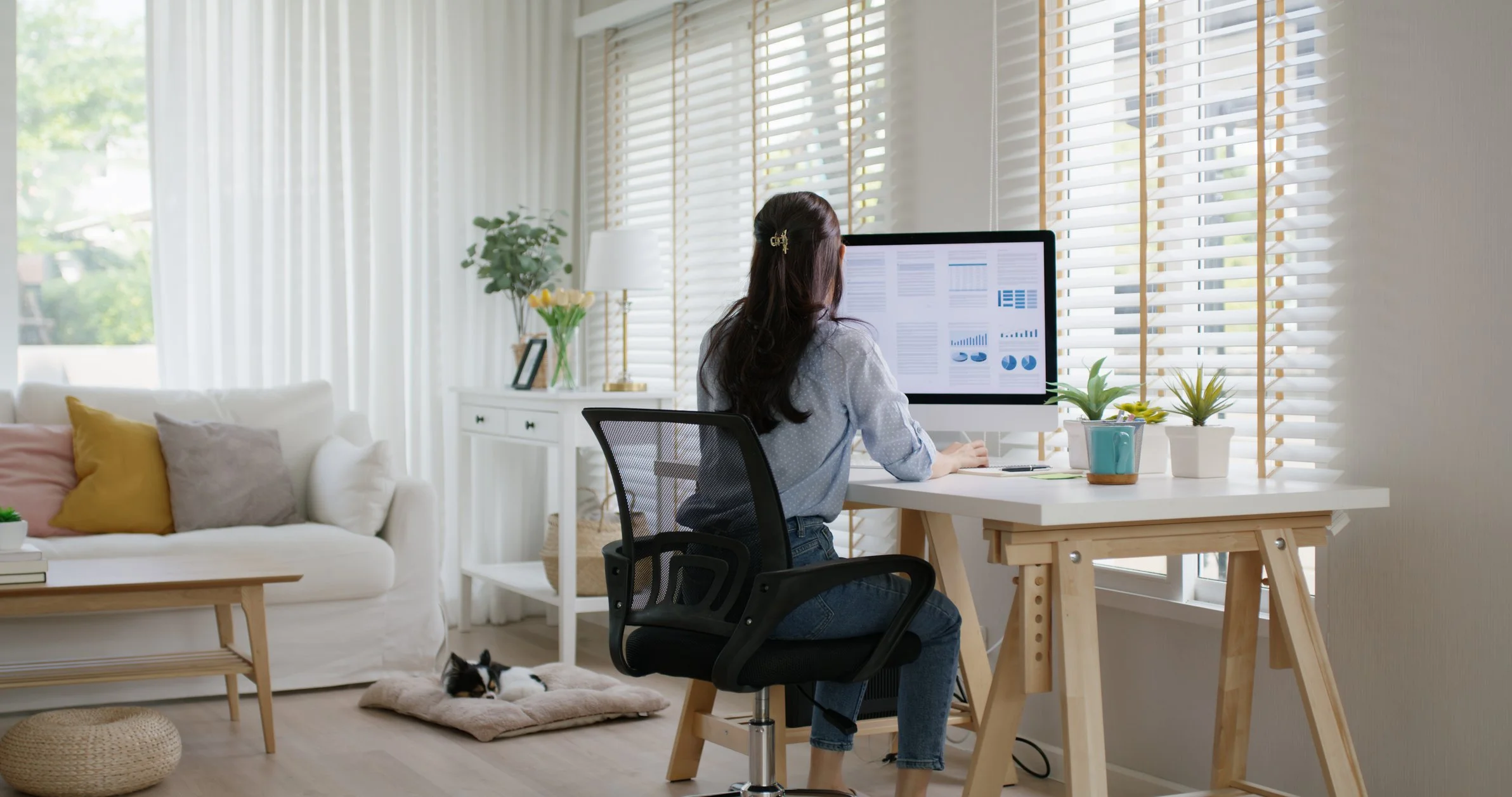
Remote and hybrid work are no longer fringe arrangements. For many businesses, they’re a permanent part of how work gets done. As remote work becomes standard, new questions emerge for employers, especially around their risk exposure. The most common, and often most uncomfortable, question is simple: if an employee is injured while working from home, is that injury covered?
The short answer is often yes, but only under specific conditions. The longer answer depends on workers’ compensation law and how courts interpret “course and scope of employment.” Employer decisions regarding telecommuting risk management also play an important role.
But this isn’t just about injury. Remote work has widened the risk landscape in more ways than many employers realize. Business owners who understand how these pieces fit together are better positioned to avoid coverage gaps and unexpected claims.
How Workers’ Compensation Applies to Telecommuters
Workers’ compensation insurance exists to cover employees who are injured while performing their job duties. In exchange for that coverage, employees generally give up the right to sue their employer. The same rules apply even when employees perform those duties at home.
Most state workers’ compensation laws do not exclude telecommuters. Courts and claims administrators instead ask whether the employee was engaged in work-related activities at the time of the injury. If the answer is yes, the claim may be compensable even if the injury occurred in a living room, basement, or spare bedroom.
For example, injuries may be covered if an employee:
Trips over a cord while moving between their desk and a printer used for work
Develops a repetitive strain injury from computer use during assigned hours
Is hurt while retrieving work materials or participating in a required video meeting
Injuries that occur during purely personal activities, even during the workday, may not qualify for coverage. Slipping in the kitchen while making lunch or injuring a knee during a personal break can fall outside workers’ compensation, depending on the facts.
This is where the legal concept of course and scope of employment becomes critical.
Understanding “Course and Scope of Employment”
Courts use “course and scope of employment” as the legal standard to determine whether an injury is work-related. While definitions vary slightly by state, the concept generally asks two questions:
Was the employee performing duties related to their job?
Did the injury occur within the time, place, and circumstances of employment?
In a traditional office setting, these questions are usually straightforward. At home, the boundaries are far less clear. Courts and claims administrators often consider factors such as:
The employee’s work schedule at the time of the injury
The connection between the activity and the employer’s business
The location where the injury occurred
The employer’s expectations for the task involved
For example, an employee who gets injured while adjusting a work chair during business hours is more likely to be acting within the course and scope of employment. An injury that occurs while carrying laundry between meetings is far less likely to qualify.
But the difficulty doesn't stop at interpretation; there’s also the challenge of investigation. Unlike office or warehouse environments, most home offices lack CCTV, witnesses, or documented layouts. This makes subrogation and factual verification nearly impossible. In these cases, the insurer is flying blind, which increases both the potential payout and the administrative cost of the claim.
Because these determinations are highly fact-specific, telecommuting claims can be harder to evaluate and more expensive to defend. Without verifiable conditions or enforceable expectations, the risk isn’t just higher, it’s murkier.
Why Home Office Injuries Create New Risk for Employers
Remote work blurs lines that were once cleanly drawn. While control may be limited, responsibility isn’t. Without clear remote work boundaries, coverage disputes can arise that would rarely surface in a traditional office, often driven by issues such as:
Limited ability to inspect or maintain home workspaces
Employees working in unsafe or poorly designed ergonomic environments
Disagreement over whether an activity was truly work-related
From a commercial insurance perspective, workers’ compensation usually responds first to a home office injury. Other business insurance policies can also become involved. Cyber liability, employment practices liability, and general liability may be impacted, depending on the nature of the incident.
Don’t Underestimate the Cyber Liability Shift
One of the most overlooked consequences of remote work is the expanded cyber attack surface. Home Wi-Fi networks, personal devices, and reduced oversight create vulnerabilities that don’t exist in a secured office environment.
Phishing, credential theft, and remote access vulnerabilities are all amplified when employees are spread across locations. Employers must view cyber insurance not as an IT add-on, but as a foundational part of their commercial strategy.
A strong cyber liability policy, paired with employee training, VPN protocols, and endpoint protection, is now essential for businesses with hybrid or remote teams.
Setting Up a Designated Workspace Policy
Requiring employees to maintain a designated workspace is an effective way to manage remote-work risks. The goal is clarity. Employers don’t need to dictate how a home is furnished, but clear expectations still matter.
A designated workspace policy typically:
Defines where work-related activities should take place
Limits coverage to injuries occurring within that space during work hours
Reinforces safe setup and ergonomic guidelines
For example, a policy may state that work should be performed at a specific desk or area, not from a couch or kitchen counter. Clear language can also explain that injuries occurring outside the designated area are less likely to qualify as work-related.
However, it’s important to acknowledge the limitations. These policies are often difficult to enforce in real-world settings. Unless employers document, inspect, or regularly verify compliance (which can be impractical), insurers may still face significant ambiguity.
Still, policies like this help insurers and courts evaluate whether an injury falls within the course and scope of employment. Clear expectations also encourage employees to think more intentionally about safety.
Additional Risk Management Best Practices
Beyond a designated workspace policy, employers can reduce exposure by taking a few practical steps. Several practical measures can help:
Document remote work arrangements. Written telecommuting agreements should outline work hours and job expectations, providing valuable clarity during a claim review.
Provide safety and ergonomics guidance. Basic guidance on workstation setup and common safety risks shows a good-faith effort to reduce exposure.
Clarify break and personal activity policies. Employees need to understand when they are “on the clock” and how breaks are treated. Clear boundaries reduce disputes over compensability.
Review commercial insurance coverage regularly. As remote work expands, businesses should confirm that workers’ compensation and general liability policies align with current operations. Even umbrella policies may need to be adjusted to reflect new risk profiles.
Specifically, businesses should assess Hired & Non-Owned Auto (HNOA) exposure. Remote employees running errands in their personal vehicles for work purposes, like dropping off equipment or meeting with clients, may unintentionally expose the company to vicarious liability.
Taken together, these steps help reduce uncertainty before an injury occurs. Clear policies and aligned coverage make remote work claims easier to manage when they do arise.
Why Commercial Insurance Strategy Still Matters
Some employers assume remote work reduces risk simply because fewer people are in the office. In practice, the risk doesn’t disappear. It shifts, and workers’ compensation exposure often becomes harder to predict.
A strong commercial insurance strategy considers where and how employees actually work, not just what their job descriptions say. For remote or hybrid teams, this requires aligning workers' compensation, cyber liability, auto exposure, and internal procedures with day-to-day operations.
Home office injuries aren’t hypothetical. Claims are already being filed and paid. Businesses that understand how workers’ compensation applies, recognize the role of course and scope of employment, and take practical steps to manage risk are far better prepared when an injury occurs.
Need Help Aligning Your Insurance with a Remote or Hybrid Workforce?
Talk to an advisor who understands how evolving work models impact your commercial insurance strategy. At Navisure, we help businesses spot coverage gaps, clarify workers’ comp exposure, and ensure your policies reflect how your team actually works, not just how they’re listed on paper.

COREY VANDERMEER | PRESIDENT
Corey started his insurance career in the claims department for a national carrier and learned the basics of insurance coverage and how it’s applied. From there he decided to take the jump into sales and joined an independent insurance agency. Here he learned how to build coverage around the needs of each individual and cater to every client. When Corey decided to start an insurance agency he did so with the intention of simplifying the process of getting insured. With a focus on technology and simplicity; his goal was to create an insurance agency that was different from those currently dominating the market place.
When he’s not working, Corey enjoys golfing, fly fishing and spending time with his wife and kids. Together they enjoy traveling to Northern Michigan and to his wife’s hometown of San Francisco.
Frequently Asked Questions (FAQ)
Q: Does remote work change my business insurance needs?
Yes, significantly. When employees work from home, your risk profile doesn’t shrink; it changes shape. Workers’ compensation exposure becomes harder to define, cyber liability risk increases due to unsecured home networks and phishing, and auto liability may emerge if employees use personal vehicles for work-related errands. A remote workforce requires a more intentional, coordinated insurance strategy.
Q: Are employees covered by workers’ compensation while working from home?
Usually yes, but only when injuries occur within the course and scope of employment. At-home claims are often harder to evaluate because insurers lack visibility into the work environment. Without witnesses, surveillance, or enforceable workspace standards, these claims become fact-heavy and more difficult (and costly) to investigate. That’s why clear policies and documentation matter.
Q: Does general liability insurance cover incidents at an employee’s home office?
In most cases, general liability exposure from a client visiting a home office is not the primary concern. While premises-related claims can occur, the more significant risk is vicarious liability, particularly when remote employees run work-related errands using their personal vehicles. Without proper Hired & Non-Owned Auto (HNOA) coverage, businesses may face uncovered losses tied to employee actions during work hours.
Q: How does remote work affect cyber liability exposure?
Remote work materially increases cyber risk. Home Wi-Fi networks are rarely as secure as corporate systems, and phishing attempts are harder to monitor across dispersed teams. The “human element” becomes the biggest vulnerability. Cyber liability insurance should be considered just as critical as workers’ compensation for remote or hybrid businesses, not an optional add-on.
Q: What about business equipment used at home?
Standard commercial property policies may not automatically cover equipment kept off-site. Laptops, monitors, phones, and other assets may require an equipment floater or inland marine endorsement to ensure coverage applies wherever employees work. This is especially important for businesses with distributed teams.
Q: Can umbrella policies help with remote work risks?
Yes, but only if the underlying policies are properly structured. An umbrella policy extends limits; it does not fix coverage gaps. If workers’ compensation, cyber, auto, or general liability policies don’t properly address remote work exposures, the umbrella won’t respond either. Alignment across all policies is essential.
Q: How often should businesses review coverage as operations change?
At least annually and immediately after any meaningful shift, such as adopting hybrid work, expanding remote roles, hiring employees in new states, or changing how work is performed. Remote work is not a “set it and forget it” risk. Coverage should evolve alongside operations to avoid surprises at claim time.